
Guidus One
izzleRole Playing
4.547.00 Reviews
- Version
- 1.0.2
- Installs
- 50.00K
- Age Rating
- Teen
Screenshots

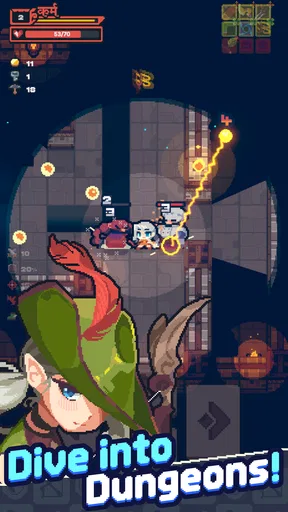



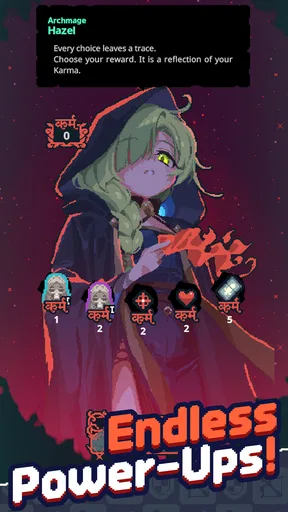

Our Review of Guidus One
 Analysis by Appyee
Guidus One is the kind of role-playing game I open when I want a run that demands attention without asking me to commit to a long story campaign. Its real-time, grid-based pixel design creates a compact but active experience: movement matters, attacks need timing, and every room can turn a promising attempt into a careful retreat. My overall view is positive, but with an important qualification: this is better suited to players who enjoy learning through repeated runs than to anyone looking for a relaxed, highly guided adventure.
Developed by izzle, the game presents itself as a roguelike RPG built around quick decisions and changing runs. That combination gives it a distinct identity on mobile. It is free to start, carries a Teen content rating, and its current version is 1.0.2. The game has already reached over 50 thousand installs and holds a 4.5 average from around 2.8 thousand ratings, which suggests that its focused design is connecting with a noticeable audience.
Why the grid makes every encounter feel deliberate
The most convincing part of Guidus One is the relationship between its grid and real-time action. In a conventional turn-based dungeon crawler, I can pause and calculate every move. Here, the grid gives me structure, but the action keeps moving. That creates a useful middle ground: the battlefield is readable, yet hesitation still has a cost.
I found myself thinking in short sequences rather than simply tapping the nearest enemy. A step toward one square can open a route around an attack, trap me against a wall, or place me too close to a second threat. This makes positioning more important than button speed. Players who enjoy watching enemy patterns and choosing a safe angle should get more from the combat than players who treat the game as a simple tap-to-attack experience.
The pixel presentation also serves the gameplay rather than existing only for nostalgia. Clear shapes and compact rooms help me read hazards and opponents quickly, especially during a busy encounter. The style is deliberately restrained, so the appeal depends less on visual spectacle and more on whether I enjoy interpreting a small combat space under pressure.
That design produces one of the game’s strongest everyday use cases. I can play a short session while waiting for an appointment or during a commute, but I still need to stay mentally present. It is not ideal background entertainment. If I start a run while distracted, I am likely to waste a good opportunity by moving carelessly, missing a threat, or spending a useful resource at the wrong moment.
Small decisions matter more than fast reactions
My most useful approach was to treat each room as a positioning puzzle before treating it as a damage race. I look for escape squares first, then consider which opponent can reach me soonest. This habit is especially valuable when several enemies occupy nearby tiles. Rushing toward the most obvious target can remove one threat while leaving me exposed to another.
A second practical lesson is to avoid entering a new area at the edge of a bad position. When possible, I finish an encounter where I still have room to move rather than ending beside a wall or in a narrow passage. That gives the next exchange a better starting point and reduces the chance that the game’s real-time pressure turns a minor mistake into a failed run.
I also recommend resisting the urge to use every advantage immediately. Roguelike games often reward players who preserve flexibility, and Guidus One’s grid makes that principle easy to feel. A resource or ability that seems unnecessary in the current room may become valuable when movement is restricted or multiple enemies converge. Even without relying on a perfect build, careful timing makes runs feel more consistent.
What repeated runs add to the experience
The roguelike structure gives the game its replay value. A failed attempt is not simply lost time; it becomes a lesson about spacing, enemy behavior, and the risks of a particular route. I enjoy that learning curve because improvement comes from understanding the game, not only from making a character numerically stronger.
That said, repeated runs will not appeal to everyone. Players who want a fixed narrative with dependable progress may find the loop less satisfying than a traditional role-playing game. The pleasure here comes from gradually making better choices and handling familiar pressures more confidently. If you dislike restarting after a mistake, the central structure may feel more frustrating than motivating.
One subtle strength is how the grid gives failure a clear cause. When I lose, I can usually identify the moment where I moved too aggressively, ignored an escape route, or allowed enemies to control the available space. That clarity is important. It makes the game feel demanding without making every defeat seem random.
The main weakness is the cost of concentration
My biggest reservation is not the pixel art or the compact format; it is the amount of attention the real-time system expects. The game can fit into a short session, but a short session is not automatically a casual session. I would not choose it when I want something soothing after a tiring day, because the same qualities that make combat engaging can make mistakes feel abrupt.
The format may also be less comfortable for players who prefer broad touch targets and generous reaction windows. Grid-based action asks me to distinguish movement from attack decisions and to read the next threat quickly. Anyone with limited patience for precise mobile controls should try it cautiously rather than assuming that its simple appearance means simple play.
There is another trade-off in the free-to-play model. Guidus One costs nothing to begin, while optional purchases range from under a dollar to nearly a hundred dollars per item. That spread is worth keeping in mind before spending. I would first decide whether the core run-based loop genuinely suits me, then treat purchases as optional support rather than as part of the basic reason to install the game.
For me, the sensible rule is simple: play long enough to understand whether failure teaches you something. If each defeat makes you curious about a better route or a safer approach, the game has probably found its audience. If every restart feels like a chore, spending more will not fix the underlying mismatch.
Who should make room for it on a phone
I would recommend this game to players who like real-time roguelike RPGs, compact pixel worlds, and combat where positioning is as important as attacking. It is particularly suitable for someone who enjoys experimenting, learning enemy patterns, and improving through several attempts rather than expecting to master everything in one sitting.
It is also a good fit for fans of mobile dungeon games who want more tension than a fully turn-based alternative provides. The grid keeps the action organized, while the real-time layer prevents me from treating every encounter as a menu of safe calculations. That makes it a stronger choice than a slower alternative when I want a focused challenge in a small package.
I would steer other players toward a different type of role-playing game. If your priority is a large story, extensive dialogue, relaxed exploration, or a character-building system that can be enjoyed while multitasking, this is probably not the right choice. The game’s appeal depends on active participation, and its concise format is not a substitute for a sprawling adventure.
The Teen rating is also relevant for families deciding whether it is appropriate. I would not describe it as a universal children’s recommendation simply because it uses colorful pixel graphics. Parents should consider the intensity of its combat and the presence of in-app purchases before handing it to a younger player.
Practical habits that improve a first session
On a first attempt, I would avoid chasing speed. Move through each room with the goal of learning how much space different encounters give you. Notice which squares remain safe after an enemy attacks, and keep one route open whenever the layout allows it. This approach makes the early experience less dependent on luck and gives you information that remains useful in later runs.
I would also play with notifications and other distractions out of the way. That sounds obvious, but it matters more here than in many idle or turn-based mobile games. A brief interruption can break my awareness of enemy positions, and recovering that awareness while the action continues is harder than simply pausing a slower game.
Another useful habit is to separate experimentation from commitment. Try a risky movement when the room is under control, not when several threats are already close. This lets you learn the limits of the grid without sacrificing every promising run to one uncertain decision.
Finally, judge progress by decision quality rather than by how far one attempt reaches. A run that ends earlier but teaches you to manage space better can be more valuable than a lucky run that gives you no understanding of why it worked. That mindset is the key to enjoying the game instead of treating every defeat as wasted effort.
What the current package says about long-term use
The current release is version 1.0.2, so I approach it as a focused experience that may appeal most to players who enjoy its core loop rather than to those expecting a huge, mature role-playing ecosystem. The store summary emphasizes the real-time grid-based roguelike identity, and that is exactly where the game’s value lies: it does not need to imitate a console-scale adventure to be engaging.
Its free entry point makes trying that identity easy. I can discover whether the movement and combat suit me without paying first, which is important because this is a taste-sensitive genre. Some players will immediately enjoy the tension between tiles and timing; others will find the same tension tiring. The ability to test the loop before considering purchases is therefore one of the game’s practical advantages.
The audience response is encouraging without changing my own judgment. A 4.5 average from thousands of ratings indicates strong reception, while the smaller review count means I would still make the decision based on the game’s specific structure rather than assuming it will satisfy every role-playing fan. Its appeal is narrow in a good way: it knows that the grid and the run are the point.
What I would like potential players to understand is that this is not merely a pixel-themed action game. The grid changes how I read danger, and the roguelike format changes how I value mistakes. Those two systems support each other, but they also create the main barrier to entry. If I want to win by reacting quickly without thinking about space, I am playing it incorrectly. If I enjoy turning limited room into a tactical advantage, the design becomes much more rewarding.
My verdict after weighing the trade-offs
Guidus One earns my recommendation for a specific kind of mobile player: someone who wants a free role-playing game with immediate action, repeated runs, and enough tactical pressure to make a small room feel meaningful. Its real-time grid combat is the feature that separates it from more conventional dungeon adventures, and its pixel presentation keeps the battlefield readable while preserving a distinct personality.
I would not recommend it blindly to every RPG fan. The short-session format can hide a demanding attention requirement, and the restart-driven structure may frustrate anyone who prefers guaranteed progress. The optional purchase range also deserves a measured approach, especially for players who are still deciding whether the loop fits their habits.
For me, the final balance is clear: this is a compact, thoughtful roguelike rather than a broad, story-heavy role-playing game. I would install it when I want to practice judgment under pressure, not when I want to relax with an uncomplicated adventure. Its best quality is that every square can become a decision, and its main weakness is that the game expects me to care about those decisions every time I play.
Verdict
Strengths of Guidus One
- Fast, responsive controls make dungeon combat feel precise.
- Randomized stages and loot give each run a fresh challenge.
- Multiple heroes offer varied abilities and playstyles.
- Pixel-art visuals are clear, colorful, and pleasantly nostalgic.
- Short runs suit quick gaming sessions on mobile.
Limitations of Guidus One
- Difficulty can spike sharply, especially during boss encounters.
- Progress may feel grindy when upgrading heroes and equipment.
- Limited story depth may disappoint players seeking narrative content.
- Frequent combat can become repetitive after extended sessions.
- Some features and rewards may depend on in-app purchases or ads.
Similar Picks in This Category
View All
Hair Dye
CrazyLabs LTD4.4

Monster High™ Beauty Salon
CrazyLabs LTD4.5

Bus Simulator - Bus Games 3D
Jima Apps4.4

Flight Pilot: 3D Simulator
Wildlife Studios4.1


Super Stylist Fashion Makeover
CrazyLabs LTD4.4
Frequently Asked Questions
What is Guidus One and what kind of game is it?
Guidus One is a mobile action role-playing game built around dungeon exploration, real-time combat, and roguelike progression. You guide characters through dangerous rooms, defeat enemies, collect equipment, and improve your team during each run. Its appeal comes from responsive controls, changing dungeon layouts, and the need to adapt your strategy rather than simply repeating the same attack pattern.
Is Guidus One free to download and play?
Guidus One can generally be downloaded and played without paying an upfront purchase price, although availability and monetization may vary by platform or region. Players should expect optional in-app purchases or other progression-related systems, depending on the current version. The game can still be enjoyed through regular play, but users who want faster upgrades or additional resources may encounter paid offers.
Does Guidus One require an internet connection?
An internet connection may be needed for downloading the game, checking updates, synchronizing progress, displaying advertisements, or using certain online services. Some gameplay elements may work offline, but this should not be assumed for every mode or feature. Before traveling or playing without mobile data, it is best to test the installed version and confirm which functions remain available offline.
Is Guidus One suitable for beginners?
Guidus One is accessible to newcomers, but it is not always easy. The basic controls are straightforward, while the combat system rewards timing, positioning, and careful observation of enemy patterns. Early failures are part of the learning process, especially when facing stronger opponents or unfamiliar rooms. Players who enjoy gradual improvement and challenging runs will likely find the difficulty satisfying.
What devices are compatible with Guidus One?
Compatibility depends on the operating system, device model, available storage, and the requirements of the current release. Guidus One should be downloaded through the official Google Play Store or Apple App Store so the store can automatically check whether your phone or tablet is supported. Keeping the operating system updated and freeing sufficient storage can also help prevent installation or performance problems.
Play our best games!


